We’re in a trust recession.
I hadn’t heard the term until recently when it came up twice in conversation. Naturally, I did what I always do — I started researching. What I discovered is what I’ve been saying to clients for some time. I just didn’t realise there was now a name for it.
You can’t scroll social media without being sold to. Aggressive DM funnels. Retargeting ads that follow you for weeks because you clicked on something once. Endless FOMO messaging. Couples are exhausted. And increasingly sceptical of what they’re being told.
For many in the wedding industry, 2026 is shaping up to be a tougher year. Yes, some businesses are having a phenomenal season upcoming. But many more — planners, venues, photographers, florists, stylists — are experiencing fewer enquiries and lower conversions. If you’re feeling like things are harder than they used to be, you’re not imagining it.
Couples are not simply being “price sensitive.” They’re being cautious and analytical about their decisions. They are slower to decide and understandably more sceptical.
It would be easy to blame couples. To label them as difficult. But that misses the point entirely. If you are operating your wedding business exactly as you were in 2023 or earlier, you will struggle. It’s important to adapt to the world we are living in AND what couples are wanting right now.
Let’s be honest. The world feels unstable. Couples are navigating increased living costs and global uncertainty. But here is the uncomfortable part we need to own as an industry:
Some of the deterioration of trust hasn’t come from the economy.
It has come from us. The Wedding Industry.
Couples are already exhausted navigating life. let alone the stress of wedding planning.
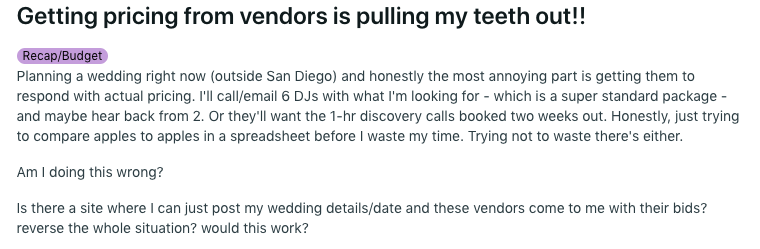
Trying to shortlist suppliers while jumping through endless hurdles just to find out whether something is within budget is draining. I wrote about this last year, and yet little has changed. I regularly see Reddit and instagram threads filled with couples frustrated by the lack of pricing transparency on supplier websites.

When Marketing Crosses the Line
There is a difference between confident marketing and manipulative marketing.
We have all seen it. False scarcity tactics. “Only one date left!” when that simply isn’t true. Countdown timers. Shaming language disguised as education. Pressure to “sign today.” And this is across the board not just the wedding industry.
Recently I listened to an international wedding educator advising suppliers not to allow couples time to think — to close the deal immediately. From a pure sales perspective, I understand the logic.
But weddings are not double glazing in the 1980s. Is this really the world we want to be back in?
Weddings are significant emotional and financial investments. If couples want time to reflect before committing thousands of pounds, give them that time. Nurture them properly. Pre-arrange a follow-up conversation. Continue the dialogue. That builds trust far more effectively than pressure ever will.
Hard selling may work in some markets. But here in the UK, it risks alienating couples before they have even signed a contract.
Passing off styled shoots as real weddings is another damaging practice. Styled shoots are valuable and creative collaborations. There is nothing wrong with them. But presenting them as genuine weddings erodes credibility. The same applies to using stock imagery to imply experience that does not exist. Couples are far more media-savvy than many businesses give them credit for.
In a recent podcast, Becca Pountney commented that she wished wedding businesses would list prices next to styled shoot images. It would help couples have more realistic expectations on what they can afford from the outset. She is absolutely right.
Couples are questioning more. Comparing more. Conducting due diligence before handing over deposits. I have had too many discussions with couples paying thousands to suppliers discovered on social media — without contracts, without credentials, without checking experience — then being shocked when said supplier lets them down or cannot deliver to expectations.
That era is ending. And frankly, it needed to. So if a couple wants to do due diligence first – let them.

Gen Z Is Changing the Game
If you have not yet considered how Gen Z is reshaping the wedding industry, now is the time. Gen Z couples are entering both the consumer space and the workforce. They do not behave like millennials.
Generation Z have grown up with social media and understand curated feeds, filters. and AI. They recognise manipulation and do not blindly trust aesthetics. They read reviews and scrutinise contracts. They compare company values. They look beyond beautiful images.
Interestingly, Gen Z often shares more in common with Gen X than Millennials do — sceptical, questioning, independent. Many are the children of Gen X, which may explain that parallel.
Millennials embraced aspirational Instagram grids and polished perfection. Gen Z is more intentional. More sustainability-aware. More budget-conscious — not because they are “cheap,” but because they refuse to begin married life in unnecessary debt. Authenticity matters more than perfection.
That shift is uncomfortable for wedding businesses built on perfectly curated feeds. For years, beautiful imagery was enough to convert. Now couples want stories behind the visuals. They want video. Behind-the-scenes insight. Personality.
So how do you attract Gen Z couples?
By offering customisable options. Communicating your values clearly. Through being accessible — whether that’s through DMs, WhatsApp or quicker enquiry routes. By showcasing real couples and real experiences. By showing how weddings actually come together, not just the polished final image.
Smaller, more intentional weddings are rising — whether driven by cost of living or changing priorities. Elopements. Destination weddings. Curated guest lists. Gen Z has little interest in conforming for tradition’s sake. They are comfortable setting boundaries. They are not inviting distant relatives out of obligation.
Transparency
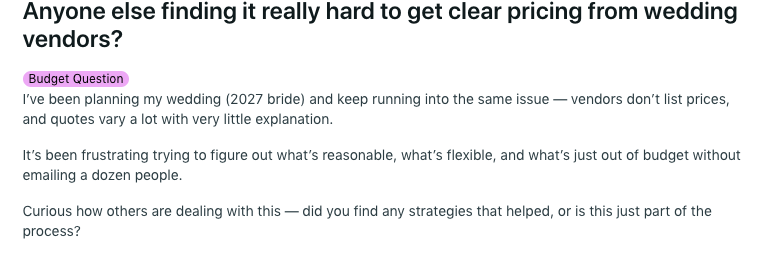
If there is one thing couples dislikes, it is having to jump through hoops for basic information — especially pricing.
They expect transparency before committing to a call. If your service is bespoke, provide guideline pricing or typical spend ranges. If couples are researching an average of fourteen suppliers and shortlisting three per category, that can equate to over forty enquiries. It is unrealistic to expect them to schedule 40+ meetings or calls just to understand price positioning!
No matter how good you are or how much they love you. Regardless of how many awards or testimonials you have. Wedding couples will have a budget – even luxury weddings have a budget! Having an understanding (even approx.) of where you fit into their budget is important. From here they can make a decision whether to jump on a call for a more detailed realistic quotation.
The “Wedding Tax” Narrative
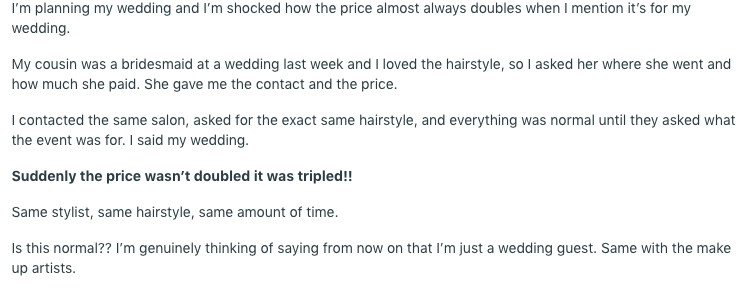
The perception that suppliers inflate prices simply because something is labelled a “wedding” still lingers.
Whether accurate or not, that belief exists. I’d hoped in 2026 that narrative would no longer be around but alas it is. Even my hairdresser said businesses charge more when it’s a wedding thus I had to educate her quickly!
Couples want justification. They want clarity around what they are paying for. Vague pricing or evasive language creates doubt.
Transparency is the only way to dismantle the wedding tax narrative. If some businesses operate unethically, the entire industry feels the impact. The solution is not defensiveness. It is openness.
So What Does This Mean for Your Wedding Business?
It means the strategies that worked five years ago will not automatically work now.
Not because you are not talented.
Because the buyer has changed.
If you rely solely on aesthetics as your marketing tool, you will struggle.
Trust now sits at the centre of every conversion. And trust is built through consistency and evidence.
When was the last time you read your website copy properly? Not skimmed it — read it through the eyes of a cautious, budget-aware couple comparing you to five other suppliers?
*80% couples discovered their suppliers online (Google, Bing etc) and *78% discovered them through social media as part of their research. Your digital visibility is not optional.
If your Instagram has not been updated since 2022, either remove the link or recommit to showing up. An abandoned platform does not signal “fully booked.” It signals neglect. In a trust recession, every touchpoint either builds confidence or erodes it.
Personality Now Matters More Than Ever
*71% couples say personality influences their final decision. They are buying the experience of working with you. Even during a time that feels uncertain and stressful.
For planners, photographers and stylists especially — roles that involve significant interaction with couples — personality is critical. Behind-the-scenes content often builds more trust than polished posts. Talking to camera. Sharing insights. Showing the work behind the work.
Yes, it can feel uncomfortable if you’ve built your brand on perfection. But honestly far better to be visibly creating a connection than delaying because you want to be perfect.
Customer Experience Must Match Your Pricing
Another uncomfortable truth: in the post-Covid surge, some businesses increased prices because they could. But service levels didn’t always increase alongside those price rises, especially when businesses found full dairies but did not have the team or systems to manage this professionally.
Couples notice slow responses. Cold impersonal automation. No DMs allowed (for goodness sake stop saying that on instagram!). Automation has its place. But over-automation strips away the personal touch.
If the world feels unstable and oh to controlled by Ai, people gravitate towards human connection. Make it easy to enquire with you AND receive a response that makes them feel special
If that means allowing DMs, voice notes, or shorter enquiry forms — just do it.

Help Couples Understand Value
Couples are under pressure to enjoy their engagement while keeping to budget amid uncertainty. role is not simply to deliver a service. It is to guide them as an authority in the wedding industry.
Explain why your pricing reflects expertise, preparation, logistics and experience. Show the return on investment — reduced stress, time saved, guest experience enhanced, creative vision realised.
Education builds authority.
Authority builds trust.
Trust drives bookings.
The Wedding Businesses That Will Thrive
The businesses that will thrive in this trust recession are not necessarily the cheapest or the loudest.
They are the ones who:
- understand exactly WHO they serve.
- communicate clearly and consistently.
- demonstrate genuine expertise.
- show real work.
- build real connection.
- operate with integrity — even when nobody is watching.
The world feels uncertain. When the world feels uncertain, people do not buy hype. They buy safety. They buy people they trust.
And that has always been your strongest marketing strategy.
Want to up-level your business in 2026? Book a call with me below and we can discuss how I might be able to help you. Or have a look at the different 1:1 services I currently offer.
Sources
* Think Splendid 2026 Global Survey
Generation Z Are Getting Married
Photo by Farlie Photography